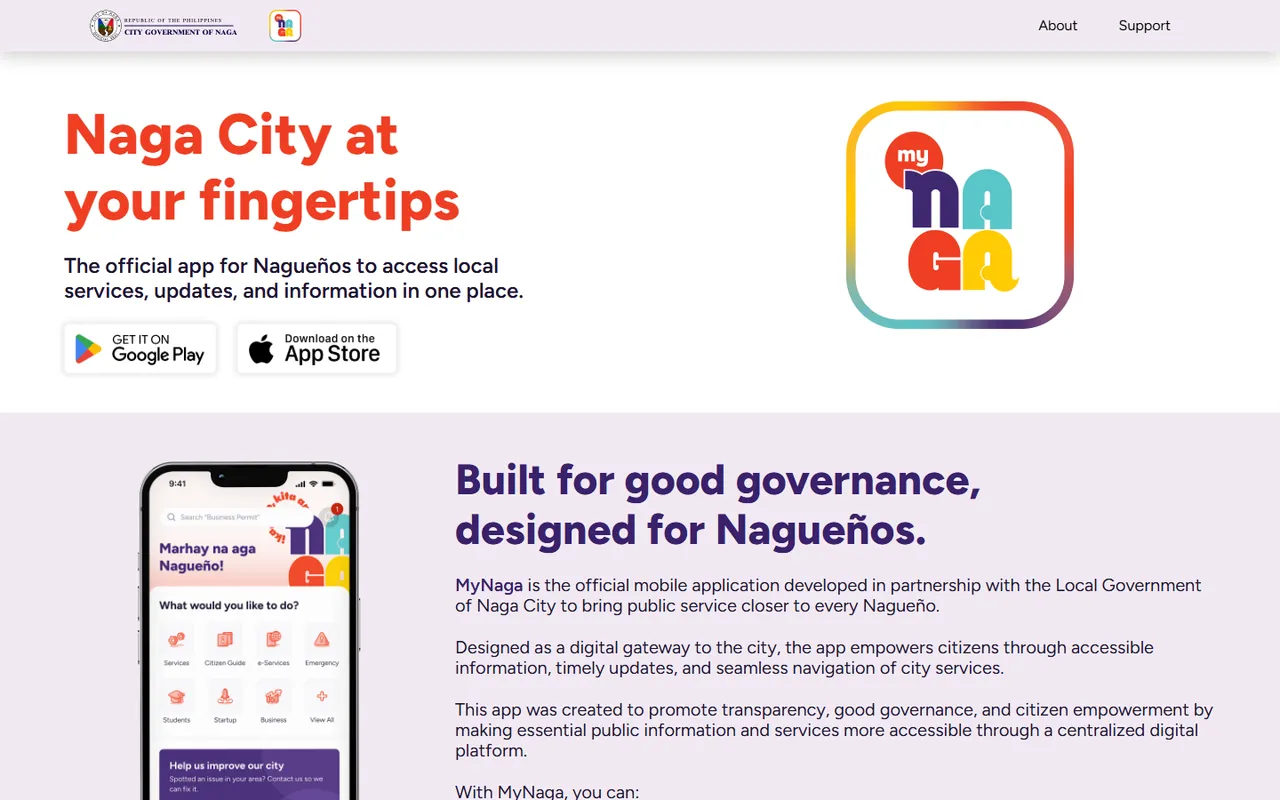
City mobile app
MyNaga App
The official mobile app of Naga City, built with EasyBus PH for the city government. It gives Nagueños one place for city service guides, official news and emergency hotlines, on iOS and Android.
Visit siteResidents expect to renew a permit, report a problem or find a hotline from their phone. Karl L. Darnayla contributed to two official city apps in the Philippines, MyNaga for Naga City and KaisaKa for Santiago City, and builds the same kind of citizen-service software for local offices, schools and associations.
In short
A citizen services app gives residents one place on their phone for the things a city or office does for them: service guides, news, emergency numbers, applications, bookings and reports. Behind it is a secure back end that the staff of the office can manage.
Clear guides to city services and official announcements in one hub, so residents stop asking where to go and what to bring.
Online requests such as business permits, property taxes and civil registry requests, so a resident does not have to queue at the office first.
In-app reporting that lets residents send community concerns and public-safety reports directly to the local government.
Hotline numbers a tap away, which matters most when the connection and the time are both short.
Facility booking and medical appointment booking, with schedules the office controls.
Apps for both platforms, backed by a REST API, so the same back end serves the phone apps and any web dashboard.
MyNaga is the official mobile app of Naga City, built by EasyBus PH in partnership with the city government. It gives Nagueños one hub for city service guides, official news and emergency hotlines on iOS and Android, and lets residents report community concerns straight to the city government. Karl contributed to it as a software developer intern at EasyBus PH, building back-end features and REST API endpoints with NestJS.
KaisaKa launched in April 2026 for Santiago City. It covers business permits, property taxes, civil registry requests and budget transparency, with online financial-assistance applications, a job portal, facility booking, public-safety reporting, medical appointment booking and a local tourism guide. Karl contributed to it in the same internship, working through Bitbucket pull requests and code reviews.
Both apps were built by EasyBus PH, and Karl contributed back-end work to them as an intern. KodebyKarl takes that experience to its own projects: secure portals, member records, attendance and event systems, and apps with a REST API that web and mobile can share, for local offices, schools, cooperatives and associations.
Mobile apps for iOS and Android can be built from one codebase with React Native or Flutter, with camera and QR scanning, location, push notifications and offline use where the job needs them, or as a progressive web app when an install is not needed.
It starts with a message and a 20-minute discovery call about who will use the app every day and which three features must work on day one. You then get a fixed written quote with milestones, and pay in three stages: 40% at signing, 30% at a working staging build and 30% at sign-off. Work runs in two-week sprints with demos, and the code is handed over when the final payment is made.
City mobile app
The official mobile app of Naga City, built with EasyBus PH for the city government. It gives Nagueños one place for city service guides, official news and emergency hotlines, on iOS and Android.
Visit siteCity services app
The citizen services app of Santiago City, built with EasyBus PH for the city government. Residents handle permits, taxes, civil registry requests and more from their phones.
Send a message and I will reply myself, usually within a day.